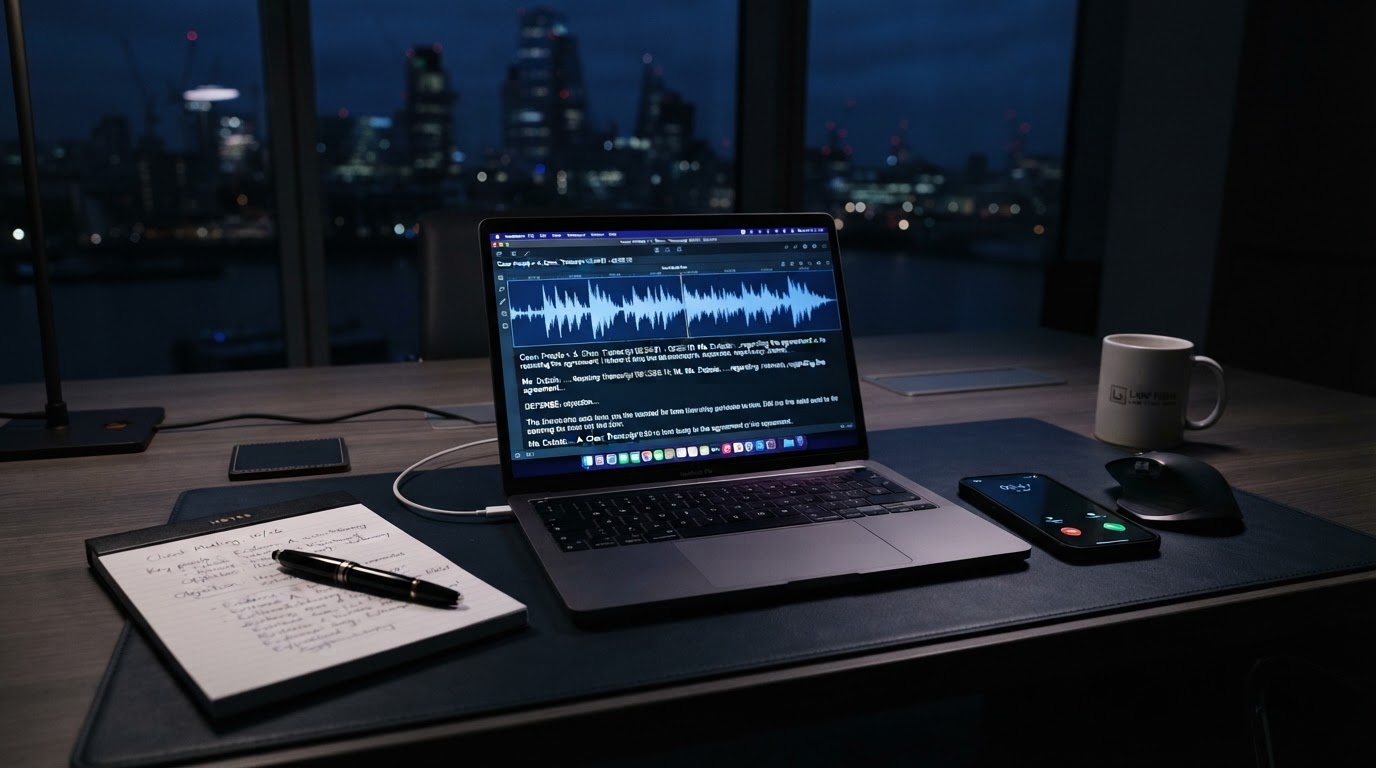
Every client conversation — whether a formal meeting, a routine call, or a brief status update — generates obligations. As a legal professional, you are expected to maintain a clear record of what was discussed, what was agreed, and what steps were taken. This is not a best practice. It is a professional requirement.
Bar associations and regulatory bodies in most jurisdictions require lawyers to keep adequate records of client communications. The specific rules vary — consult your local bar association's guidance for the precise obligations in your jurisdiction — but the underlying principles are consistent: clients deserve accurate documentation of the advice they receive, and lawyers need contemporaneous records to protect themselves if a dispute arises.
Inadequate documentation creates risk in three distinct directions: disciplinary exposure, civil liability, and evidentiary weakness.
The Three Risks of Poor Documentation
1. Disciplinary exposure
If a client files a complaint with your bar association and your file contains no contemporaneous notes of the conversation in question, your account of events will be difficult to substantiate. A clear record protects your licence.
2. Malpractice liability
Legal malpractice claims often turn on contested facts: what advice was given, whether a deadline was communicated, whether the client was warned of a risk. Contemporaneous, dated documentation is typically the most reliable evidence available. Without it, disputes become credibility contests.
3. Evidentiary weakness in ongoing matters
In litigation or regulatory proceedings, the quality of your file affects the quality of your case. Notes made at the time of the conversation carry significantly more weight than reconstructed accounts prepared afterward.
Common Mistakes in Manual Note-Taking
Most lawyers understand, in principle, that they should document client calls. The challenge is doing it consistently and accurately under the conditions of real practice.
The most common failure is delay. When a call ends, the next matter is already waiting. Notes get written hours later, from memory, and important details are compressed or lost. What felt clear immediately after the call becomes approximate by evening.
The second common failure is incompleteness. Handwritten or quickly typed notes tend to capture conclusions and action items but miss the reasoning and the client's exact words. In a subsequent dispute about what was communicated, those omissions matter.
A subtler problem is reconstruction bias. When you write notes after the fact, you naturally frame events in the light of what happened next. A contemporaneous record captures the state of knowledge at the time — which is usually what matters legally.
Finally, there is the problem of format. Notes scattered across different notepads, emails, and apps are hard to retrieve and easy to overlook. A consistent, searchable documentation system is not a luxury; it is a prerequisite for effective practice management.
Best Practices for Documenting Client Conversations
Write notes during or immediately after. The value of a record is directly proportional to its proximity to the event. Even rough contemporaneous notes are more reliable than polished reconstructions.
Record what was said, not just what was decided. Capture the client's position, questions, and concerns, not only your conclusions. If a client declines your advice on a particular point, note that explicitly.
Include date, time, participants, and medium. Every record should clearly identify when the conversation occurred, who was present, and whether it was a phone call, video meeting, or in-person discussion.
Confirm significant points in writing. For important advice, decisions, or next steps, follow up with a brief email or letter to the client summarising what was discussed. This creates a second layer of documentation and gives the client an opportunity to correct any misunderstanding.
Maintain a consistent filing system. Notes should be stored in a predictable, retrievable location — in the client file, not in a personal notebook that leaves when you leave.
Where AI-Assisted Transcription Fits In
Transcription tools have become genuinely useful for legal practice — not as a replacement for professional judgement, but as a way to create more accurate records with less effort.
A tool like XMOX can transcribe a recorded client call and produce a searchable text record within minutes. That record can then be reviewed, annotated, and filed as part of the client's matter. The result is a more complete account of the conversation than most lawyers produce manually, created at a fraction of the time cost.
A few considerations for using transcription in legal practice:
Consent and confidentiality. Before recording any client call, confirm that recording is permitted under your local rules and that the client has consented. Client confidentiality obligations apply to recordings and transcripts just as they do to other file documents. Understand where your transcription provider stores data and what their data-handling commitments are.
Review before relying. Automated transcription is accurate but not infallible, particularly with technical legal terminology, multiple speakers, or poor audio quality. Treat a machine-generated transcript as a draft — review it and correct material errors before filing.
Integration into your workflow. Transcription is most useful when it fits naturally into an existing process. Record the call, transcribe it, review and annotate the transcript, and save it to the client file. The bottleneck is no longer note-taking; it is review and judgement — which is precisely where your expertise belongs.
A Practical Starting Point
If you want to improve your documentation practices, the most important change is the simplest: document closer to the event.
Whatever method you use — handwritten notes, a dictation app, or an AI transcription tool — the habit of capturing the substance of a client conversation while it is still fresh will improve your file quality more than any formatting convention or software.
For practices that handle a significant volume of client calls, or that regularly deal with matters where factual disputes are foreseeable, investing in structured transcription is worth the effort. It reduces the memory load on your staff, creates more defensible records, and frees you to focus on the work that actually requires your judgement.
XMOX offers a free account to get started — no long-term commitment required. Upload a recording, see how the transcription looks, and decide whether it fits your practice.
Start free →